Heads up: MAM is closed Tuesdays (not Mondays — a common mix-up with other Milwaukee museums). The Burke Brise Soleil only flaps when winds are under ~23 mph sustained — high-wind days, the wings stay locked closed for safety. Call (414) 224-3200 the morning of your visit if conditions look gusty.
Key Facts
- Venue
- Milwaukee Art Museum
- Address
- 700 N Art Museum Dr, Milwaukee, WI 53202
- Hours
- Closed Tuesdays · Mon/Wed/Fri/Sat/Sun 10 a.m.–5 p.m. · Thu 10 a.m.–8 p.m.
- Adult admission
- $27 (Seniors/Students/Military $20, Kids 12 & under FREE, Members FREE)
- Free / pay-what-you-wish
- Every Thursday 4–8 p.m. · Bank of America cardholders free first full weekend monthly
- Burke Brise Soleil schedule
- Opens with the Museum (10 a.m.), flaps at noon, folds 10 p.m. nightly — weather permitting
- Brise Soleil specs
- 90-ton, 72-fin wings with a 217-foot wingspan, designed by Santiago Calatrava
Cross-reference verified against each venue's own website and Milwaukee press.
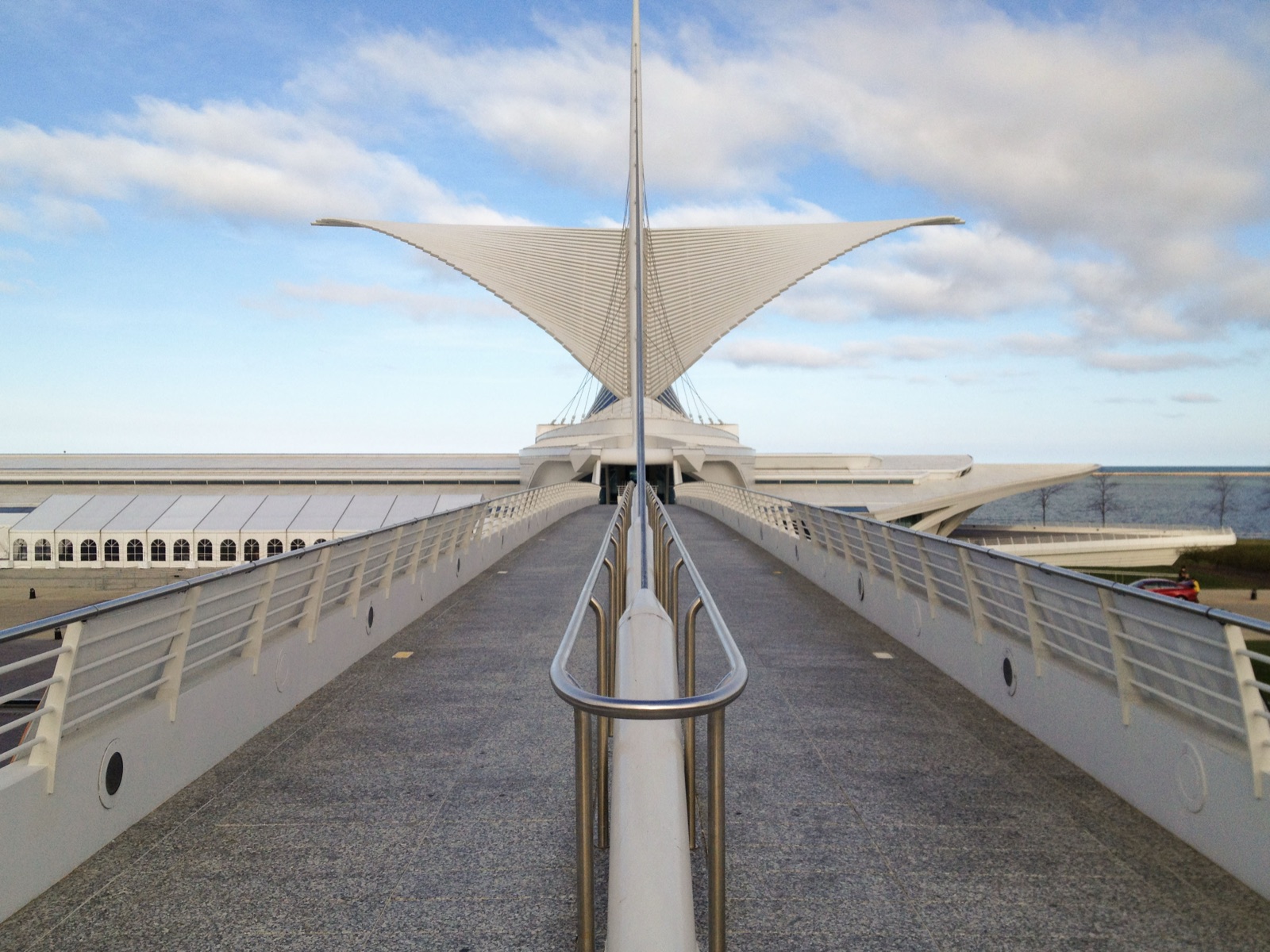
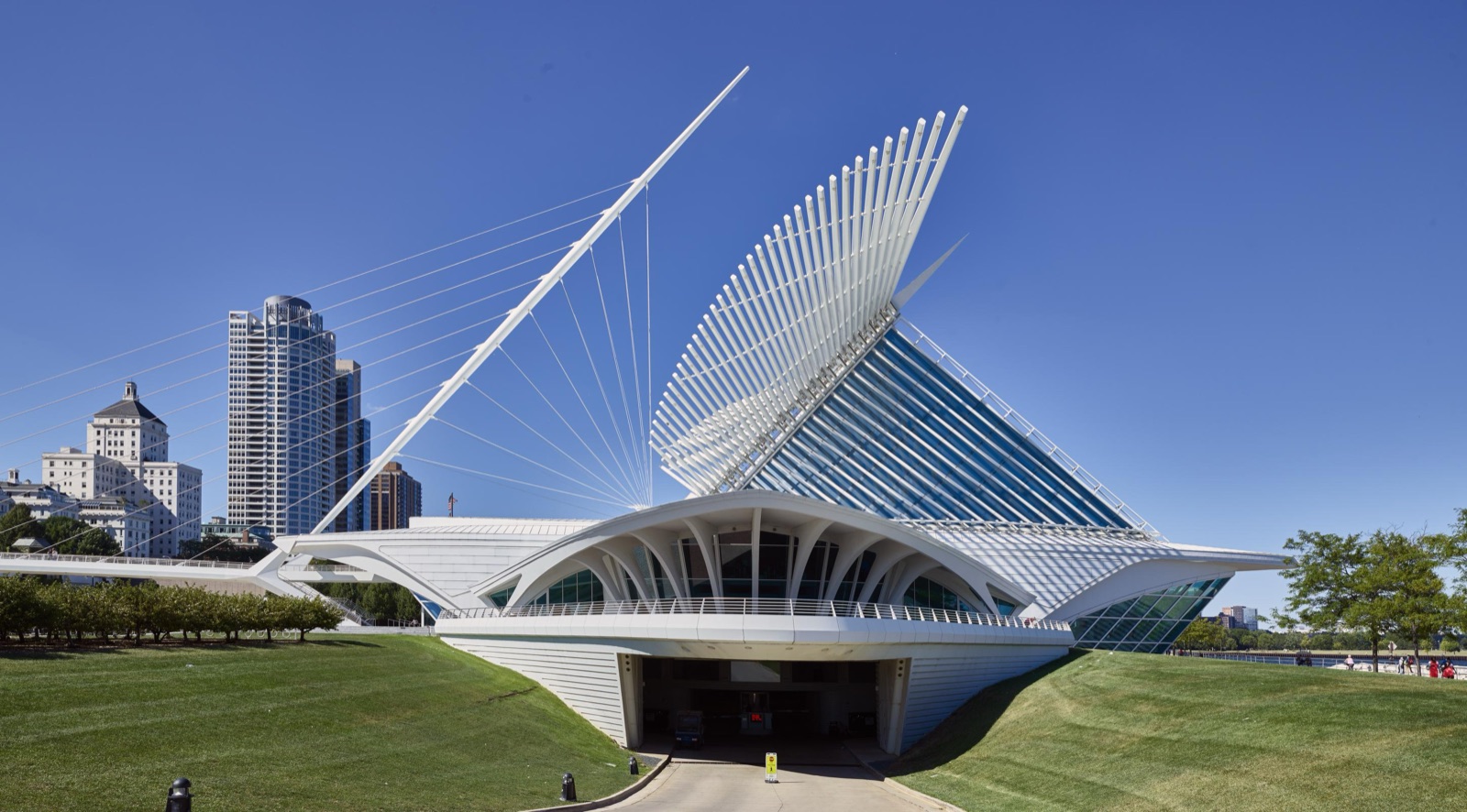
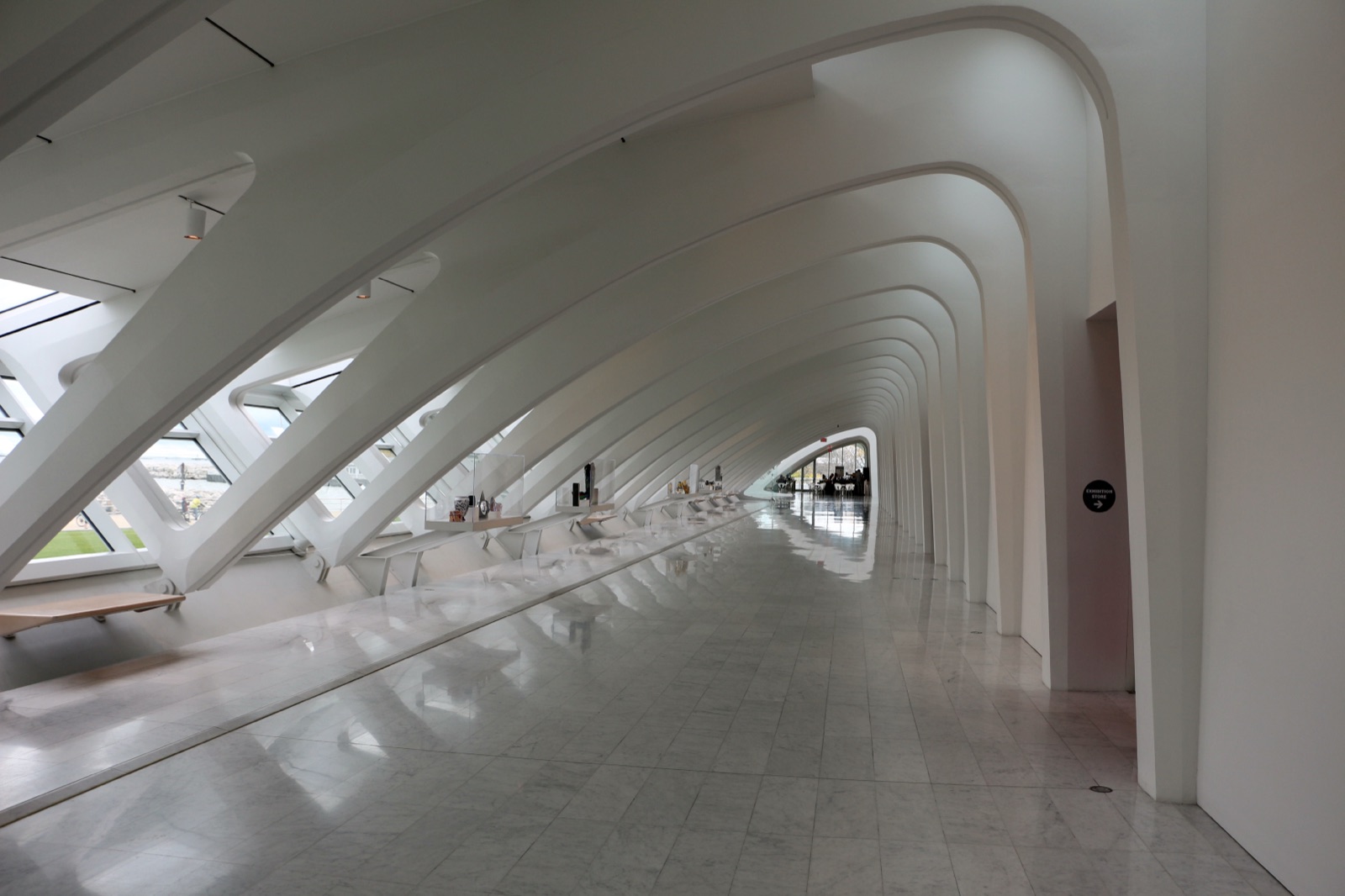
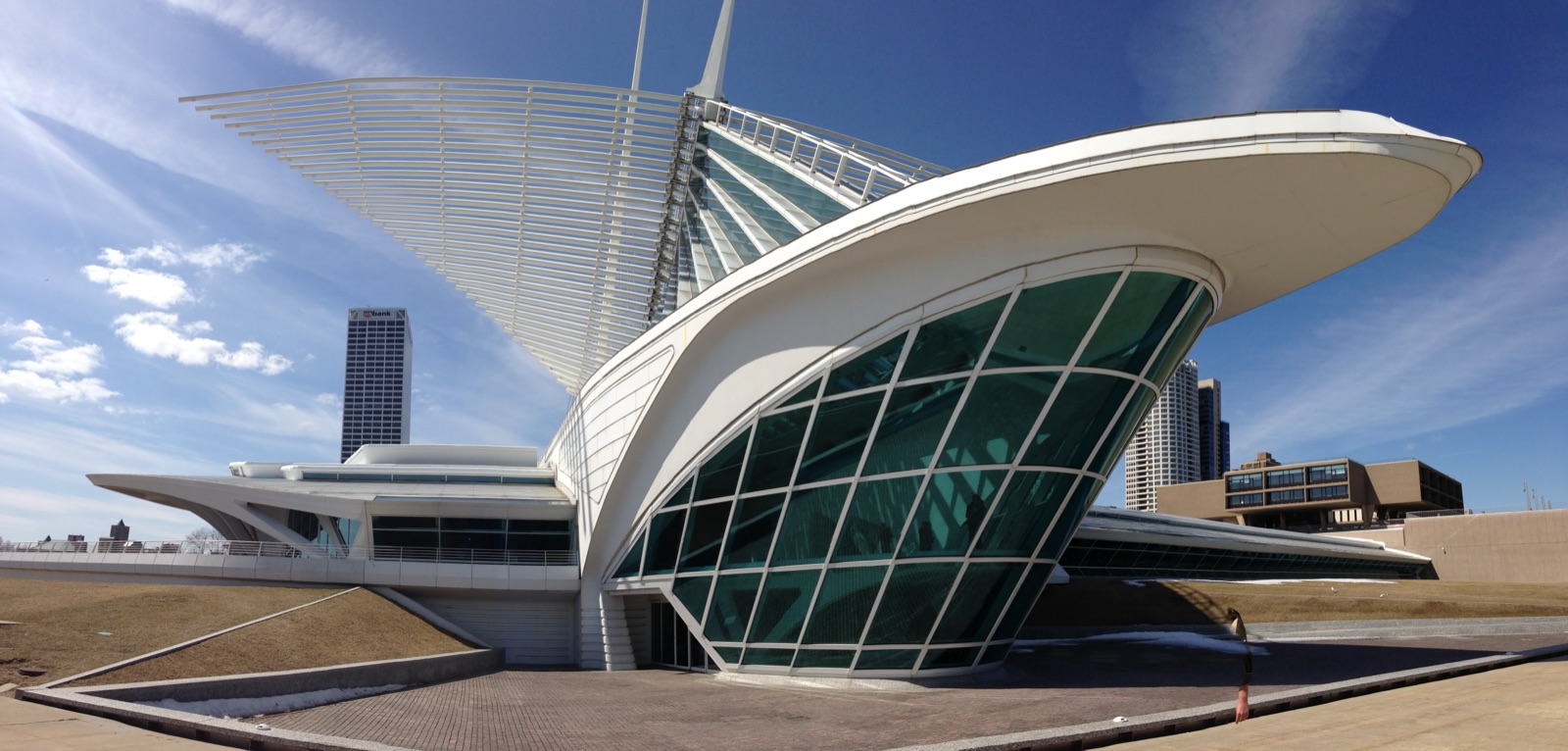
Photos via Wikimedia Commons. Credits: Nicholas Hartmann (CC-BY-SA-4.0); Carol M. Highsmith (CC0); Sailko (CC-BY-3.0); Uriel-carmen (CC-BY-SA-3.0).
Milwaukee Art Museum at a Glance
The essentials, verified against mam.org in June 2026.
Address
700 N Art Museum Dr, Milwaukee, WI 53202 — on the downtown lakefront
Hours (verified June 2026)
Mon 10–5 · TUE CLOSED · Wed 10–5 · Thu 10–8 · Fri–Sun 10–5
Admission start price
Adults $27 · Seniors/Students/Military $20 · Kids 12 & under FREE · Members FREE
Free / pay-what-you-wish
Every Thursday 4–8 p.m. (pay-what-you-wish) + Bank of America cardholders free the first full weekend of every month
Brise Soleil flap times
Opens with the Museum (10 a.m.) · Closes and reopens at noon · Closes at 10 p.m. nightly (wings stay lit even on Mondays when the Museum is closed) — weather and wind permitting
Architecture
Three buildings: Saarinen War Memorial (1957) + David Kahler Building (1975) + Calatrava Quadracci Pavilion (2001)
Collection size
30,000+ works spanning antiquity to today across ~40 galleries
Best for
Architecture, photography, families, lakefront walks, rainy days, free Thursday-night dates
Time needed
2–3 hours minimum · 4+ hours for the full collection and a Café Calatrava (Lakeshore Café) lunch
Parking
Calatrava underground garage on site (1–2 hr: $10 · 3–6 hr: $14 · 12+ hr: $26) · Museum Center Park Garage early bird $10
The Burke Brise Soleil (Calatrava Wings)
The 90-ton, 72-fin movable sunscreen (217-foot wingspan) that put Milwaukee on the global architecture map. Calatrava's only completed U.S. building project at the time of its 2001 opening, and still the country's most theatrical museum entrance.
10:00 a.m. — Daily opening
The 90-ton, 72-fin Burke Brise Soleil (217-foot wingspan) unfolds with the Museum's opening. This is the slowest, longest take — the wings rise from a closed clamshell to full extension over roughly 3.5 minutes.
12:00 noon — The midday flap
The wings close completely and then reopen. This is the photographer's window — the only daytime moment when you can watch a full close-and-open cycle without leaving the lakefront.
10 p.m. — Nightly fold
The wings fold back down at 10 p.m. every night, taking another ~3.5 minutes — they keep this lighting schedule even on Mondays when the Museum is closed.
Weather cancellations
Sustained winds of 23 mph trigger an automatic safety lock via the wings' ultrasonic wind sensors — common on windy spring and fall days. Snow, ice, and lightning also cancel the flap. Call (414) 224-3200 the morning of if conditions look rough.
Best Viewing & Photo Spots
- Cudahy Gardens / Reiman Bridge approach — the textbook frontal shot looking east, with the spars opening directly toward you.
- North side, from the War Memorial lawn — captures the wings against Lake Michigan with fewer crowds.
- From the Reiman Bridge itself — the underside-and-spine view is unusual and underrated.
- From Discovery World's lakefront promenade ~10 minutes south — pulls the whole Calatrava silhouette together against downtown.
- Boat or kayak from the lagoon — best on calm summer mornings; rent kayaks at the lagoon in season.
Photo tip
The midday noon close-and-reopen is the only daytime full cycle. Set up at the foot of Cudahy Gardens 10 minutes early — the wings start moving on the dot. For golden hour, the 10 p.m. nightly fold drops the wings against a lit downtown skyline — year-round, even Mondays when the Museum is shut.
Hours & Admission
Verified against mam.org/visit in June 2026. Closed major holidays — call ahead for Thanksgiving, Christmas, and New Year's Day.
Hours
10 a.m.–5 p.m.
CLOSED
10 a.m.–5 p.m.
10 a.m.–8 p.m.
10 a.m.–5 p.m.
10 a.m.–5 p.m.
10 a.m.–5 p.m.
Free / Discounted Days
Pay-what-you-wish every Thursday 4–8 p.m. (walk-up only, no online tickets needed). Bank of America cardholders get free admission the first full weekend of every month through the Museums on Us program — just show your B of A debit or credit card and photo ID at the admissions desk.
The Three Buildings
Three architects, three eras, one campus. MAM is one of the only American art museums where the building history is a curriculum in 20th-century architecture all by itself.
Quadracci Pavilion (2001)
Santiago Calatrava
The white, winged reception hall that put MAM on the global map. Named TIME magazine's Number One design of 2001, this 142,050-square-foot building was Calatrava's first completed work in the United States. Houses Windhover Hall (the cathedral-like reception space under the wings), the auditorium, special-exhibition galleries, the MAM Store, and Café Calatrava (now branded the Lakeshore Café). The Reiman Bridge — Calatrava's pedestrian cable-stay span — connects the Pavilion across Lincoln Memorial Drive to downtown.
Kahler Building (1975)
David Kahler
The brutalist concrete galleries that hold most of the permanent collection. Reimagined and reopened in November 2015 after a $34M renovation that added 25,000 sq ft of gallery space (150,000 sq ft total) and reorganized the floors around natural lakefront light. This is where you find the bulk of the American, European, Modern, Contemporary, Folk & Self-Taught, and Decorative Arts galleries. Don't skip it — the Pavilion is the icon, but the Kahler is the museum.
War Memorial Center (1957)
Eero Saarinen
The original lakefront building — a floating cantilevered cross of poured concrete that Saarinen designed as both a memorial to fallen veterans and a home for the merged Layton Art Gallery and Milwaukee Art Institute collections. The building still serves both functions: it houses MAM galleries on the lower levels and the Milwaukee County War Memorial above. It became the Milwaukee Arts Center, then was renamed the Milwaukee Art Museum in 1980.
The Collection (30,000+ Works)
MAM grew from the 1957 merger of the Layton Art Gallery and the Milwaukee Art Institute — both founded in 1888. Today, it holds one of the country's strongest folk-art collections, the iconic Bradley Collection of Modern Art, and deep Old Master prints and drawings holdings.
American Art (17th–20th c.)
Strong holdings from colonial portraiture through 19th-century landscape and the early 20th-century moderns. Includes works by Winslow Homer, John Singer Sargent, Mary Cassatt, Charles Sheeler, and the regionalist painters. Anchored by The Layton Collection — the museum's founding gift from Frederick Layton in 1888.
European Art (15th–20th c.)
Paintings, sculpture, prints, and drawings from the late Renaissance through the early 20th century. Old Master prints and drawings (a particularly deep strength), 19th-century French painting, and the German Expressionists that came in through the Bradley gift.
Modern & Contemporary
The Bradley Collection is the anchor — Margaret 'Peg' Bradley's 1975 gift of 600+ Modern works, including Fauvist paintings, German Expressionist canvases by Wassily Kandinsky and Ernst Ludwig Kirchner, and a major group of works by Georgia O'Keeffe. The Bradley Collection of Modern Art: A Bold Vision for Milwaukee retrospective marked its 50th anniversary in 2025–26.
American Folk & Self-Taught Art
One of the largest holdings of American folk and self-taught art in any general art museum, transformed by the 1989 Michael and Julie Hall Collection gift. Includes face jugs, weather vanes, quilts, decoys, Grandma Moses, Bill Traylor, Henry Darger, and the Wisconsin self-taught traditions.
American Decorative Arts (Chipstone partnership)
Since 1999, the Milwaukee-based Chipstone Foundation has partnered with MAM to display rotating selections of its American furniture, ceramics, and silver in dedicated galleries. The pottery and Pennsylvania-German collections are especially strong.
Photography, Prints & Drawings
Major photography holdings (with strengths in contemporary American work), and one of the deeper Old Master prints-and-drawings collections in the Midwest. The Print, Drawing, and Photography Study Center allows researchers and the public to view works on paper not on gallery view.
Indigenous & Native Art
MAM's permanent installation Homelands: Mnë'nának, Māēnāēwah, Tešišik centers Indigenous voices and works from the lands now called Wisconsin, including Menominee, Ho-Chunk, and Potawatomi artists. The complementary installation Knowledge Beings is also ongoing.
Summer 2026 Exhibitions
On view as of June 2026 — verified against mam.org/exhibitions. All exhibitions are included with Museum admission and free for members.
Currents 40: Widline Cadet
Through August 9, 2026The 40th installment in the Currents series highlighting an emerging contemporary artist. Cadet's photography and video work explores Haitian diasporic memory, family archives, and the visibility of Black women in image-making.
Gertrude Abercrombie: The Whole World Is a Mystery
Through July 19, 2026A major retrospective of the Chicago Surrealist whose haunted self-portraits, moonlit landscapes, and dream tableaux made her a fixture of the jazz-age Chicago scene. Closes in mid-July — go early-summer if you can.
Gertrude & Friends: The Wisconsin Magic Realists
Through October 25, 2026A companion show pairing Abercrombie with the Wisconsin Magic Realist circle — Marshall Glasier, John Wilde, Karl Priebe, and Dudley Huppler. The long run window means it pairs well with a fall return trip.
Seeking Revelation: German Romantic Prints and Drawings
June 19 – November 1, 2026Opens June 19, drawing on MAM's deep European works-on-paper holdings to trace the Romantic search for the sublime through Caspar David Friedrich's circle and the Nazarenes. The summer's big print-and-drawing show.
The Layton Collection (ongoing)
Permanent installationFrederick Layton's 1888 founding gift of 38 paintings — the original collection that became MAM. Reinstalled as a permanent gallery; required viewing for the institutional history.
Homelands: Mnë'nának, Māēnāēwah, Tešišik (ongoing)
Permanent installationMAM's permanent installation of Indigenous art and material culture from the lands now called Wisconsin — Menominee (Māēnāēwah), Ho-Chunk, and Potawatomi (Mnë'nának) contributions.
Knowledge Beings (ongoing)
Permanent installationCompanion installation drawing on Indigenous epistemologies and contemporary Native artistic practice.
Café Calatrava / Lakeshore Café
The on-site restaurant in the Quadracci Pavilion — informally still called Café Calatrava by locals; currently branded the Lakeshore Café. Floor-to-ceiling lakefront windows, Wisconsin-leaning menu, Valentine Coffee Roasters drip and espresso.
Café hours
Wed–Mon 10 a.m.–4:30 p.m. · Closed Tue · Hot kitchen 11 a.m.–3 p.m.
What to order
Valentine espresso · seasonal Wisconsin plates · local beer · house-made sweets · seasonal lakefront patio service
The seats to ask for
The north-wall tables facing Lake Michigan — the patio when weather allows. Members get 10% off all dining purchases.
Admission needed?
No — café access does not require Museum admission. You can come for coffee and the lakefront view alone.
MAM Store & Membership
The MAM Store sits inside the Quadracci Pavilion (members 10% off). Memberships are the cheapest way to visit more than twice a year.
Membership Levels (2026)
Discounted tier for WIC, FoodShare, BadgerCare, or Medicaid participants.
One full-time enrolled student; ID required.
One adult + children under 18.
Two adults + children under 18.
Adds reciprocal admission at 500+ museums, VIP festival access.
Reciprocal access at 1,000+ museums, curator events, travel.
Adds Art in Bloom access, complimentary parking, private docent tours.
Math check
A $115 Family/Dual membership pays for itself in three visits for two adults ($27 × 2 × 3 = $162). The $250 Art Advocate level adds reciprocal admission at 500+ museums — one 2-day out-of-town museum trip in Chicago or Minneapolis can effectively cover the upgrade.
Lakefront Festival of Art 2026
MAM's signature annual outdoor festival — and 2026 brings new extended evening hours for the first time.
2026 Dates
Friday, June 12 – Sunday, June 14, 2026
Fri & Sat 10 a.m.–7 p.m. (new extended evening hours), Sun 10 a.m.–5 p.m.. 145 juried artists from Milwaukee and around the country, live music, local food and drinks, lakefront in full color. Ticket pricing: $22 advance / $27 at the gate for single-day general admission, $40–$45 for a 3-day pass; kids 12 and under and Wisconsin K–12 teachers are free.
Festival weekend is the busiest of MAM's year. The new Friday–Saturday 7 p.m. closing means an after-work or golden-hour visit is realistic for the first time — go Friday evening if you want to wander the festival, catch the wings on their evening close, and avoid the Saturday crush.
Parking, Accessibility & Practical Tips
Everything you wish you'd known before you arrived.
Parking
Calatrava Underground Garage (on-site, climate-controlled, accessible spaces): free for 15 min or less · $7 for under 1 hr · $10 (1–2 hr) · $12 (2–3 hr) · $14 (3–6 hr) · $16 (6–12 hr) · $26 (12+ hr). Enter from Lincoln Memorial Drive or Michigan Street.
Museum Center Park Garage (alternative, just west): $10 early bird (enter by 10 a.m., exit by 9 p.m.) · $9 (30 min–1.5 hr) · $12 (1.5–3 hr) · $14 (3–7 hr). Weeknight $7 and weekend $10 evening rates available. Often the cheapest all-day option.
Accessibility
Wheelchairs free at the admissions desk. Elevators to all Museum levels and to the Reiman Bridge. Service animals and mobility Segways permitted. Wheelchair- and stroller-accessible throughout. Lockers in the East End and Pavilion for bags larger than 13×17 inches. For specific accommodations (ASL tours, sensory-friendly hours, large-print materials), contact (414) 224-3200 or mam@mam.org in advance.
Practical Tips
- Buy tickets online in advance — same price, no admissions-desk line. The Thursday pay-what-you-wish window (4–8 p.m.) is the exception and is walk-up only.
- Tuesday is the closed day, not Monday. Plan around it — Monday is one of MAM's quieter days and a sneaky-good visit.
- If the Brise Soleil flap is the reason you're going, aim for the noon close-and-reopen on a calm-weather day. Sustained winds over 23 mph cancel it; the museum doesn't pre-announce — call ahead if winds look high.
- The Reiman Bridge entrance from downtown is the dramatic approach. Drive-in visitors arriving via the parking garage emerge into the Pavilion's lower level — fine, but you miss the cathedral moment.
- Lockers in the East End and Pavilion fit bags larger than 13×17 inches. Wheelchairs are free at the admissions desk; service animals welcome.
- Selfie sticks and drones are not allowed anywhere on campus. Flash photography is prohibited in the galleries.
- Members get free parking discounts at the Calatrava garage, 10% off at the MAM Store and Café, plus reciprocal admission at 500+ museums at the $250 Art Advocate level (and 1,000+ at the $500 Donor level) — a 2-day out-of-town museum trip almost pays for the membership.
- Lakefront Festival of Art weekend (June 12–14, 2026) is the busiest of the year — extended hours Fri & Sat until 7 p.m. mean an after-work or golden-hour visit is realistic for the first time.
Pair Your Visit: Lakefront Walks
MAM sits in the middle of Milwaukee's most walkable lakefront stretch. Pair the museum with one or two of these on the same day.
Discovery World
~10 min walk south
Science and tech museum on the lakefront — pairs naturally with MAM for a full lakefront museum day. Both share the Lakefront Bike & Pedestrian Path.
Veterans Park
Immediately north
92-acre lakefront park with paved trails, the lagoon (kayak rentals in summer), and an off-leash dog area. The Brise Soleil makes its best photo backdrop from the park's southwest corner.
Northwestern Mutual Tower & Commons
~5 min walk west
The Mason Street side gives you the Tower's atrium garden, free to walk through during business hours — Milwaukee's most striking new skyscraper interior.
Lakefront Bike & Pedestrian Path / Oak Leaf Trail
Runs past the front door
A 3.2-mile lakefront loop starts here, links to the Hank Aaron State Trail and Lakeshore State Park (22-acre prairie just south of Discovery World).
Bradford Beach
~12 min drive / 25 min walk north
Milwaukee's main public beach with the Beach Cantina, volleyball courts, and views back south toward the Calatrava silhouette.
Lakefront Brewery
~10 min drive northwest (across the river)
Riverwest brewery with the legendary Friday fish fry and polka. A classic 'museum-then-fish-fry' pairing.
Cudahy Gardens
Immediately west of the Pavilion
The Dan Kiley-designed formal gardens that frame the Calatrava approach. Best view of the wings from the foot of the gardens looking east.
Betty Brinn Children's Museum
~5 min walk west
If you're traveling with kids under 10 who burn out of art galleries, this is the perfect chaser — and both are in the O'Donnell Park area.
More Milwaukee Guides
Frequently Asked Questions
Tap a question to expand.
Get Weekly Milwaukee Updates
Museum openings, exhibition launches, lakefront festivals, and insider tips every Wednesday.
Subscribe Free